
Key takeaways
- Specify the complete canvas and source behavior before selecting panels.
- Evaluate bezel visibility from the nearest critical viewing position.
- Mount tolerance and service access determine whether alignment can be maintained.
- Accept the wall with production sources, layouts and failure scenarios.
Define the operational job and canvas
Start with what operators or viewers must see: one large dashboard, many independent sources, live video, maps, dashboards, presentations or a rotating combination. Record the number and native resolution of sources, critical text size, update rate, aspect ratios, viewing distances and whether users need to move, crop, scale or save layouts.
The physical grid should follow this content model. A 2×2 presentation wall, a 3×3 security display and a long retail feature wall may use similar panels but require different controllers, structures and service strategies. Create example layouts before asking for hardware.
Judge panel and bezel behavior in the real viewing context
LCD video walls create visible seams between active images. Published bezel terminology can be inconsistent, so ask for the exact measurement definition and view a representative assembly. The effect depends on content, nearest distance, alignment and ambient light. Fine grids and faces reveal seams more than dark backgrounds or separated information zones.
Also review luminance, contrast, viewing angle, anti-glare surface, orientation and intended operating profile for the exact panel. If color matching matters, define the tolerance and calibration process instead of assuming adjacent units will look identical out of the box.

Design source resolution and controller architecture together
Map every source from output connector to final region. Decide whether daisy chaining, an external video-wall controller, matrix switcher, media server or software canvas manages the layout. Record maximum input and output resolutions, refresh rates, scaling, HDCP behavior where relevant, window count, presets, redundancy and control interfaces.
The combined physical pixel count may exceed any single source. Determine whether content is rendered at full-wall resolution, scaled by a controller or distributed across outputs. Test small text, motion and latency with production sources; a specification-sheet maximum does not describe every multi-window workload.
Engineer the structure for repeatable alignment
The supporting wall or frame must carry the installed load and remain sufficiently flat and stable. Specify mount type, micro-adjustment range, portrait support if needed, pop-out or other service mechanism, cable space and access to adjustment points. Coordinate with a qualified structural professional for the site.
Panel gaps, depth and rotation should be measurable during installation. Use a documented sequence and tools rather than visual estimation alone. Confirm that one panel can be removed without stressing neighbors and that technicians can restore alignment after service.

Plan power, cooling and cable management for the assembled wall
Aggregate power and heat across all panels, controllers, source devices and network equipment. Coordinate circuits, isolation, startup and shutdown, surge strategy and equipment-rack cooling. Avoid trapping exhaust air behind a tightly enclosed structure; verify clearances and the room HVAC assumptions.
Label power, signal and control cables by source, destination and panel position. Keep bend radius and connector access in mind. As-built diagrams reduce troubleshooting time when a single quadrant loses signal or a device is replaced years later.
Calibrate appearance and operating behavior
Use consistent settings as a baseline, then calibrate brightness, white point and color to the project’s needs. Record values and measurement method. Uniformity across a wall is influenced by panel variation, viewing angle, content and aging; define what constitutes acceptance and how future replacements are matched.
Configure input restoration, scheduled operation, panel addressing and controller presets. Test power loss and recovery in the intended sequence. If the room is mission critical, define what remains visible during source, controller or network failure and which components need redundancy.

Accept and support the complete installation
Acceptance should include physical alignment, seam consistency, visible defects, color and luminance consistency, all production sources, saved layouts, scaling, motion, control, audio if used, network and power recovery, alarms, documentation and safe service access. Capture photographs and configuration exports.
Hold compatible spare panels or define a replacement strategy appropriate to the project. Record model and revision, because later substitutions can differ in color, mechanics or control behavior. Train support staff to isolate source, controller, cable, panel and power faults before dispatching parts.
LCD video wall decision matrix
| Layer | Key decision | Acceptance method |
|---|---|---|
| Canvas | Grid, content, sources and viewing distance | Production layout review |
| Panels | Bezel, luminance, orientation and color target | Representative wall inspection |
| Controller | Resolution, windows, presets and redundancy | Source and layout test |
| Structure | Load, tolerance, access and removal path | Alignment and service test |
| Operations | Calibration, recovery, spares and records | Handover scenario test |
Practical tool
Video wall RFQ checklist
- Grid and total canvas dimensions
- Nearest/farthest viewing positions
- Source count, connector and resolution
- Windowing, presets and control requirements
- Bezel measurement and appearance target
- Wall structure, mount and service direction
- Power, cooling, rack and cable plan
- Calibration, spares and acceptance tests
Frequently asked questions
What is an LCD video wall?
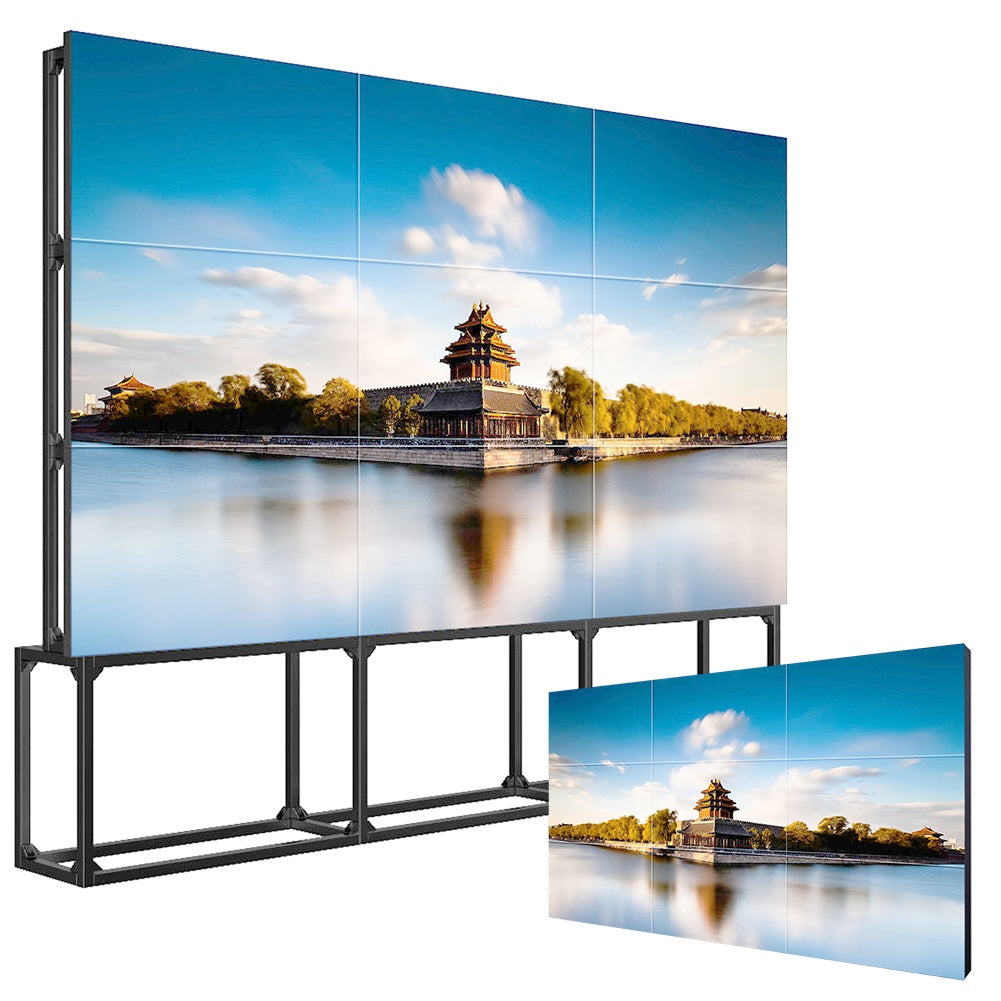
It is a tiled display canvas formed from multiple LCD panels, mounts and signal/control equipment operating as one visual system.
How important is bezel size?
It matters most when critical content crosses seams or viewers are close. Controller behavior, alignment, color and serviceability can be equally important.
Does every video wall need an external controller?
No. The answer depends on source count, layout, scaling, presets, resolution and redundancy. Simple walls may use integrated functions; complex walls often need dedicated processing.
Can one failed panel be replaced?
Often yes if access, compatible spares and calibration are planned. Verify the exact mount and replacement process before installation.
What should be tested at handover?
Alignment, appearance, all sources and layouts, control, recovery, service access, documentation and any project-specific redundancy scenario.
Sources and further reading
Continue your research: Explore LCD video wall configurations · Discuss a video wall project
Editorial note: Product configurations, applicable standards and site requirements vary. Confirm the exact model, destination and project scope before procurement.