

Key takeaways
- Verify claims at model level and keep the supporting document.
- Use a production-representative sample as the golden configuration.
- Ask how hardware, firmware and suppliers can change after approval.
- Evaluate service workflow and communication speed with the same rigor as product appearance.
1–2. Confirm the company and application fit
First verify the supplier’s legal business identity, manufacturing or trading role, relevant locations, export experience and the entity named on the quotation, invoice, warranty and bank account. The goal is a coherent commercial chain, not a collection of unrelated names. For a higher-risk order, use independent due diligence appropriate to the contract value.
Next test application fit. A capable manufacturer for indoor kiosks is not automatically the best source for outdoor, touch or video-wall work. Provide the use case, site, duty, interfaces, installation and service constraints, then ask for an exact configuration and comparable deployment evidence where available.
3–4. Require model-specific specifications and compliance evidence
Request a controlled specification for the quoted model: dimensions, weight, panel, luminance, operating conditions, power, ports, player configuration, material and finish, mounting, accessories and software versions. Record which values are typical, guaranteed or configurable. Marketing pages can guide discovery but should not replace the approved technical record.
If safety, EMC, energy, environmental or ingress claims matter, ask which standard, model and issuing body the evidence covers. Check that names and model references match the offered product. Regulatory responsibility depends on destination and configuration, so qualified local advice may be necessary.
5. Evaluate a production-representative sample
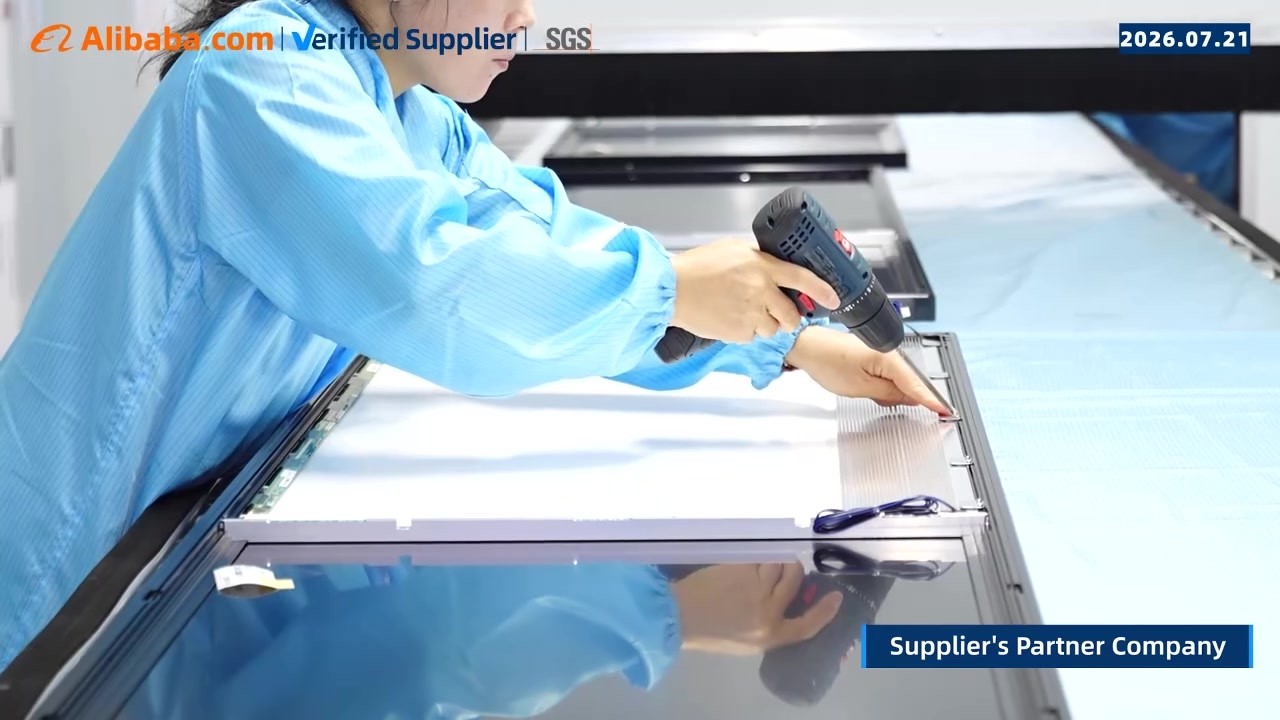
The sample should represent intended panel, player, enclosure, ports, finish and software. Test production content, color and uniformity, touch if applicable, audio, ports, CMS enrollment, scheduled playback, network loss, power recovery, continuous operation, service access, accessories and packaging. Record serial number, software versions, settings and deviations.
After approval, designate the sample or its complete record as the golden configuration. If the factory cannot explain how production will be compared with that baseline, the sample is only a demo—not a control mechanism.
6–7. Audit quality control and change management
Ask for a process map from incoming inspection through assembly, in-process checks, aging or run testing, final inspection, cleaning and packing. Review actual forms or anonymized records, sampling logic, nonconformance handling, calibration where relevant and who has authority to stop shipment. Evidence should connect to the product being ordered.
Change control is crucial for integrators. Define whether the panel, mainboard, Wi-Fi module, power supply, firmware, ports, dimensions or packaging may change; how notice is given; who approves; and what regression tests follow. A substitute that appears equivalent can break CMS behavior, mounts or field procedures.

8. Prove software and system integration
List the CMS, application, operating system, codecs, input sources, peripherals, network security requirements, remote-management method and recovery expectations. Test the exact combination on the approved hardware. Generic Android compatibility is not evidence that enrollment, watchdog behavior, device owner mode or production media will work.
Create a version-controlled golden image or configuration. Define who owns app updates, firmware changes, credentials, certificates, time settings and factory reset behavior. Integration records should be usable by both deployment and support teams.
9–10. Review capacity, packaging and logistics realistically
Capacity is more than a monthly number. Ask about the line and process that will build the order, critical-component lead times, peak-season constraints, pilot timing, production schedule, inspection window and change freeze. Compare these answers with the proposed delivery date and your approval dependencies.
Inspect packaging through actual handling risk: product restraint, screen and corner protection, moisture control where needed, accessory organization, labels, palletization and unloading. For new packaging or difficult routes, a pilot shipment can expose damage modes before a large release.

11–12. Test service design and communication before committing
Clarify warranty period and start point, covered parts and labor, exclusions, evidence required, diagnosis workflow, response target, replacement method, freight responsibility, advance replacement if any, spare availability and repair documentation. Avoid treating “warranty included” as a complete service plan.
Finally, evaluate communication as operational evidence. Give the supplier a realistic technical question and observe whether the answer is timely, specific, versioned and internally consistent. A sourcing relationship depends on escalation, engineering access and disciplined records long after the sales call.
Manufacturer sourcing scorecard
| Area | Evidence to request | Red flag |
|---|---|---|
| Company and fit | Legal chain and relevant product experience | Different entities without explanation |
| Product and compliance | Controlled model spec and applicable reports | Family-level claims only |
| Sample and QA | Test record, golden unit and inspection forms | Unrecorded demo sample |
| Change and integration | Notification process and compatibility log | Silent substitutions allowed |
| Service and delivery | Packaging proof, RMA flow and responsibilities | Warranty described only as a duration |
Practical tool
12-point manufacturer due-diligence checklist
- Legal identity and commercial chain
- Application and product-family fit
- Controlled model specification
- Applicable compliance evidence
- Production-representative sample
- Incoming/in-process/final QA records
- BOM and firmware change control
- Player/CMS compatibility proof
- Capacity and lead-time basis
- Packaging and pilot shipment
- Warranty, spares and RMA workflow
- Engineering communication and escalation
Frequently asked questions
Is a factory audit enough to select a manufacturer?
No. It can verify processes and facilities, but model fit, sample results, commercial terms, integration and service still require separate evidence.
What is a golden sample?
It is an approved production-representative unit or complete configuration record used as the baseline for production and later changes.
How should buyers verify certifications?
Confirm the applicable standard, exact model or family, named entity, issuing body, validity and relevance to the destination and configuration.
What should a manufacturer disclose before changing components?
The proposed part or firmware, reason, affected models and orders, dimensional or functional impact, evidence and regression-test plan.
Should price be part of the scorecard?
Yes, but compare total landed and lifecycle scope after minimum technical, quality and service requirements are met.
Sources and further reading
- Gemdragon Display official website
- NIST supply-chain risk management guidance
- Gemdragon factory quality-control video
Continue your research: Learn about Gemdragon Display · Send a sourcing checklist
Editorial note: Product configurations, applicable standards and site requirements vary. Confirm the exact model, destination and project scope before procurement.