
Wall-Mounted Digital Signage in Leased Retail Space: Agree the Work and the Exit
A responsibility matrix and condition record for retail teams coordinating wall-mounted displays with the requirements of leased premises.
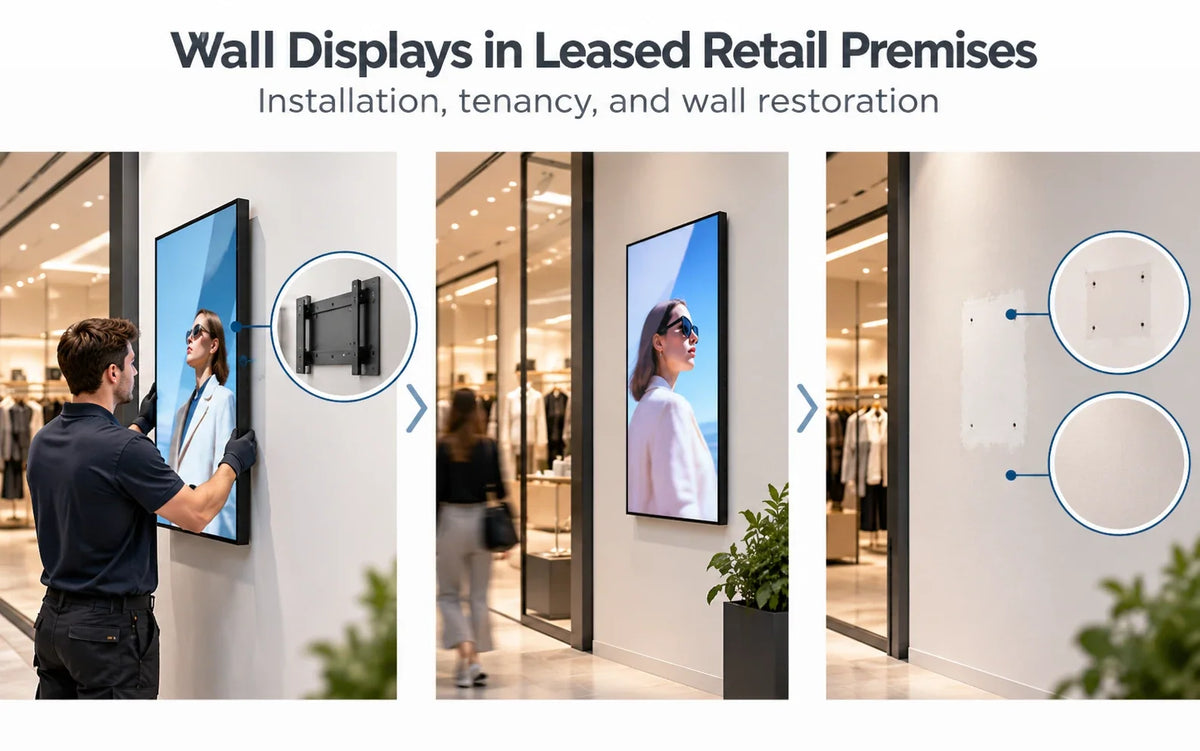
Cover reference: ChatGPT conceptual cover illustration. It is not a Gemdragon installation photograph, field test, or product configuration drawing.
Two documents can govern the same wall while describing different things. The display quotation covers equipment and supplied work. The lease or alteration consent may govern what can be attached, who maintains it, and what happens when the tenant leaves.
Close that gap before the purchase order. A useful signage brief assigns the wall work, equipment ownership, service access, and removal responsibilities alongside the selected display. It does not try to decide the lease from a hardware specification.
Settle four questions beyond screen size
Who authorizes work on this wall? Identify the lease provisions, property process, and people responsible for approval.
Who owns the installed parts? Record the display, bracket, player, enclosure, and cabling separately where their ownership or disposition differs.
Who restores the affected finish? Include fixing holes, cable openings, trim, and adjacent surfaces in the discussion.
Who performs and pays for site services? Assign power, data, and any building work before the equipment scope is priced.
New York City's Small Business Services commercial leasing guide, particularly its sections on altering and returning space, provides a useful local example of these decisions. It discusses approval, responsibility for improvements, and removal or restoration at the end of a lease. Use it as a question guide, not as a universal classification of a wall display. The actual agreement and appropriate professional advice determine the obligations for the premises.
Split the work into assignable items
Break the installation into work items and assign each one before comparing quotes. A blank responsibility column is a useful warning while planning; it should not disappear just because the display order is ready.
Scroll horizontally if needed to compare all columns.
| Work item | Decision to record | Supporting record |
|---|---|---|
| Display, mount, and player | Supplier scope, installation party, and owner | Itemized quote and asset schedule |
| Fixings and backing | Who assesses the wall and provides the approved attachment | Site assessment and matching drawing |
| Opening or reinforcement | Who reviews and performs the building alteration | Applicable consent and drawing revision |
| Power and data | Trade scope, access, and interface with equipment | Approved route and service information |
| Trim or protective enclosure | Supplier, compatibility review, and service method | Assembly specification |
| Removal and restoration | Which parts leave, who removes them, and accepted finish condition | Written agreement and condition record |
The table is a project worksheet. It deliberately avoids labeling every component as a legal fixture or assigning building work to the display supplier. Those answers need to come from the parties responsible for this site.
Compare quotations against the completed scope. A lower equipment price does not settle an omitted wall repair or an unassigned electrical connection.

Keep an asset schedule that survives a staff change
Build the asset schedule with the approval record. List the display, mount, player, protective parts, and cabling. For each, identify the owner, maintenance responsibility, and agreed disposition at handover or lease end.
The mount and display deserve separate entries. One may be reused while another is removed, but that outcome needs agreement rather than an assumption based on the invoice.
Concealed cabling also needs a decision. Record the approved treatment if the equipment moves or leaves. Do not assume cable can be abandoned in the wall, or that removing it is always appropriate; have the site team establish the permitted scope and any associated restoration.
Include later additions. A protective cover or relocated outlet can change the work and the exit plan after the original display installation. Update the record when the change is agreed.
Store the schedule where the people managing the premises can find it, with a link to the AV service records. A marketing asset list alone may not reach the person handling the lease exit.
Record the wall before work begins
Photograph and describe the visible condition before installation. Include existing holes or damage, finish references if available, adjacent surfaces affected by the proposed work, and the position identifier. A photograph helps document condition; it does not establish the concealed wall structure or a suitable fixing method.
Use a shared condition record where the parties agree one. Joint acknowledgment can clarify what was observed without making a legal conclusion about the evidentiary value of a signature.
Scroll horizontally if needed to compare all columns.
| Condition field | Before installation | At removal or handover |
|---|---|---|
| Existing finish and visible damage | Dated photographs and description | Comparison and agreed repair scope |
| Fixing positions | Installer's approved location record | Treatment of each affected position |
| Cable route | Accepted route and access points | Agreed retained or removed parts |
| Adjacent surfaces | Areas affected by access or finishing | Condition after work |
| Exceptions | Existing issues and unresolved decisions | Action and responsible party |
Our VESA and mounting checklist covers equipment-interface questions. The condition record complements it; it does not replace a qualified assessment of the wall.

Agree the exit while discussing the installation
Ask which items must be removed, which may remain, who performs the work, and how the resulting condition will be accepted. Have the relevant parties resolve ambiguous wording before treating it as a priced obligation.
Put the accepted scope beside the installation revision. If the design changes from a surface bracket to a recessed assembly, revisit the removal and finish work as well as the equipment cost. A drawing revision can change the future repair task.
Include the software side when equipment is transferred or removed. Accounts, content, licenses, and management access need their own disposition. The decommissioning guide addresses that handoff.
Bring any insurance, contractor, permit, or specialist-review requirements into the project schedule through the appropriate site advisers. Avoid assuming a dedicated circuit, permit exemption, contractor qualification, or approval duration from a generic article.

Frequently asked questions
Does a wall-mounted display count as a fixture?
Have the adviser reviewing the actual agreement assess that question. The project can help by describing the attachment and separately listing the display, mount, cabling, and agreed disposition.
Who pays for removal and repair?
Record the answer agreed under the lease and consent in the itemized scope. The supplier's display price should not be treated as an answer to an unassigned building-work obligation.
What can I provide before the property review is complete?
Send the proposed location, available wall information, preferred display, and a summary of known constraints. Mark the unresolved site decisions so the quotation can distinguish confirmed equipment from work still being defined.
Prepare a quotation brief without sharing the entire lease
A summary from the responsible adviser is usually more useful to the equipment discussion than a private contract. Include the selected wall position, available space, installation party, power and data scope, access restrictions, and any agreed removal constraints. Keep sensitive lease and personal details within the appropriate project channels.
The site-pack checklist covers delivery and access preparation. Use the same position identifiers in both records.
Request a Quote for Ultra-Thin Wall-Mounted Digital Signage with the requirements already known. Touch and system options can be discussed separately from the parties' responsibilities for the wall.
Product photos, catalog renders, and video stills are supplied Gemdragon materials with source-specific captions. Covers and diagrams are conceptual illustrations, not field measurements or installation approvals.