
Key takeaways
- Compare complete installed systems at the same canvas size.
- Evaluate seams or pixel structure with real content and distance.
- Confirm structure, heat, power and service access.
- Do not infer LED quality from the technology label alone.
Define the viewing task and room
Record the closest critical viewer, farthest viewer, content type, smallest information, ambient light, camera use and operating schedule. A control room with dense text has different priorities from a distant lobby feature wall.
Establish the physical canvas required before comparing technologies. Otherwise proposals may quote different sizes and create a false price comparison.
Understand the visible structure of each canvas
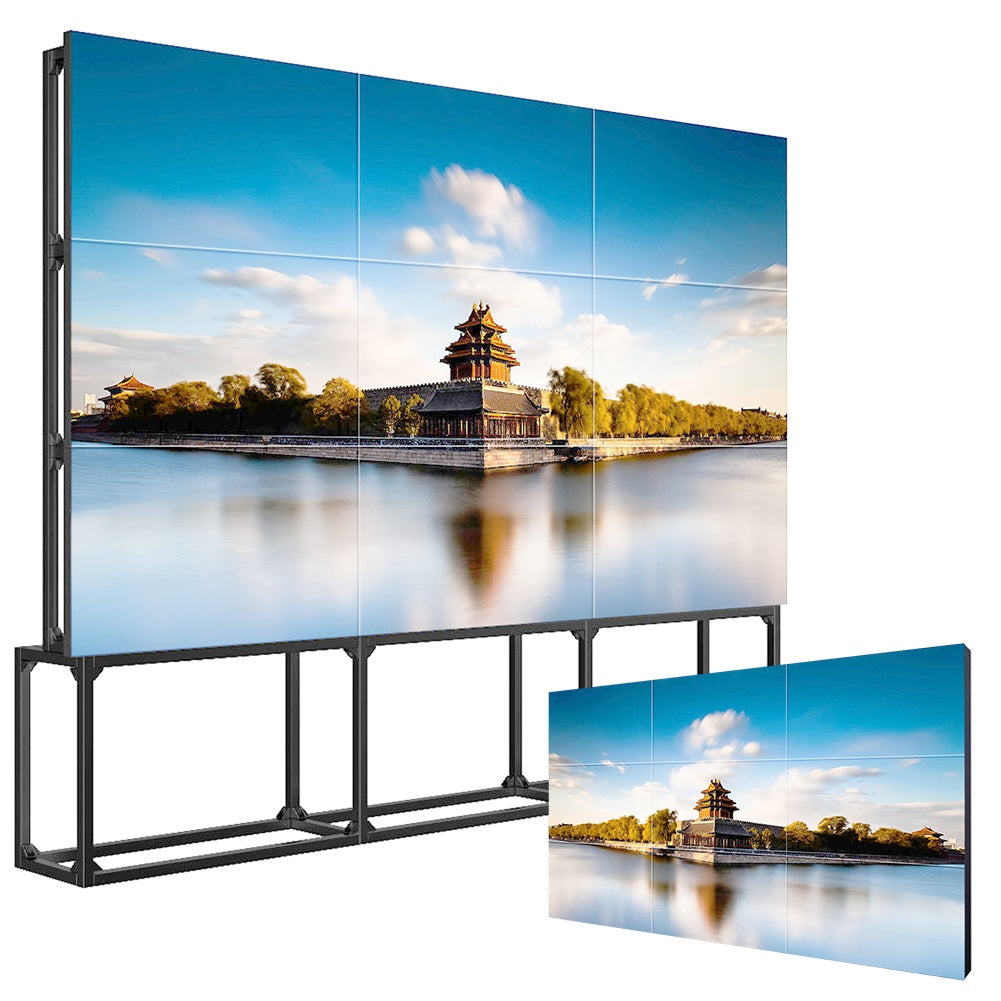
LCD video walls use complete flat panels and therefore create a bezel grid. Direct-view LED uses modules and cabinets; it removes LCD-style bezels but introduces a pixel pitch whose structure may be visible at close range.
View production content from the closest and typical positions. Inspect text edges, skin tones, gradients, dark scenes and camera capture rather than relying on promotional footage.

Compare image and content behavior
Check native canvas resolution, scaling, black level, contrast in room light, off-axis viewing, refresh and color behavior. Direct-view LED resolution depends on physical dimensions and pitch; an LCD array derives from panel resolution.
Plan content for the actual pixel map and seam or module structure. Critical labels should remain within safe zones and avoid unnecessary rescaling.
Engineer structure, power and thermal conditions
Review wall load, mounting precision, wall flatness, airflow, electrical distribution, signal transport and access. Both technologies require engineered support; the details and service modules differ.
Ask for installed power assumptions at realistic content levels and environmental conditions. Separate maximum ratings from the planning scenario and confirm local electrical design.

Design service and spares before purchase
For LCD, confirm front-service mounting and panel replacement alignment. For LED, confirm front or rear module access, receiving-card and power-supply replacement, calibration data and compatible spare batches.
Document who can perform field work, tools required, expected diagnosis process and spare storage. Technology choice should reduce operational risk for the actual support team.
Compare lifecycle evidence, not category claims
Normalize canvas size, controller, structure, power, installation, calibration, commissioning, spares, maintenance and downtime. A lower display line item may not be the lower installed cost.
Use a model-specific visual sample or mockup and an acceptance plan. Record approved content, distance, brightness setting, controller versions, color reference and service procedure.
LCD and direct-view LED decision matrix
| Factor | Tiled LCD | Direct-view LED |
|---|---|---|
| Canvas structure | Visible bezel grid | No LCD bezels; pixel pitch matters |
| Close viewing | High panel pixel density | Requires suitable pitch and content test |
| Scalability | Panel-grid increments | Flexible cabinet/module canvas |
| Service | Panel and mount access | Module, card and power access |
| Cost comparison | Normalize full installed scope | Normalize pitch, size and spares |
Practical tool
Technology comparison checklist
- Required physical canvas
- Closest critical viewing distance
- Smallest text and content type
- Acceptable seams or pixel structure
- Ambient light and camera use
- Wall, power and thermal design
- Service method and spare batch
- Installed lifecycle cost and sample test
Frequently asked questions
Is direct-view LED always seamless?
It avoids LCD bezels, but module alignment, calibration and pixel pitch still affect visual continuity.
Is LCD always sharper?
Not universally. Compare the exact LCD array and LED pitch at the intended size and viewing distance.
Which is brighter?
Model ranges vary. Use site light and real content rather than a category assumption.
Which costs less?
It depends on size, pitch or bezel class, controller, structure, installation, spares and service.
Can both technologies show multiple sources?
Yes, with an appropriate controller and tested source/window architecture.
Sources and further reading
- Gemdragon LCD video wall collection
- AVIXA display image size calculators
- NIST lifecycle cost guidance
Continue your research: Review video-wall total cost · Discuss the technology choice
Editorial note: Product configurations, applicable standards and site requirements vary. Confirm the exact model, destination and project scope before procurement.