Windows 10 IoT 2016 LTSB: Plan Your Signage Migration
The final monthly update for Windows 10 IoT Enterprise 2016 LTSB is October 13, 2026. Identify affected players, compare migration routes and check whether your displays can stay.
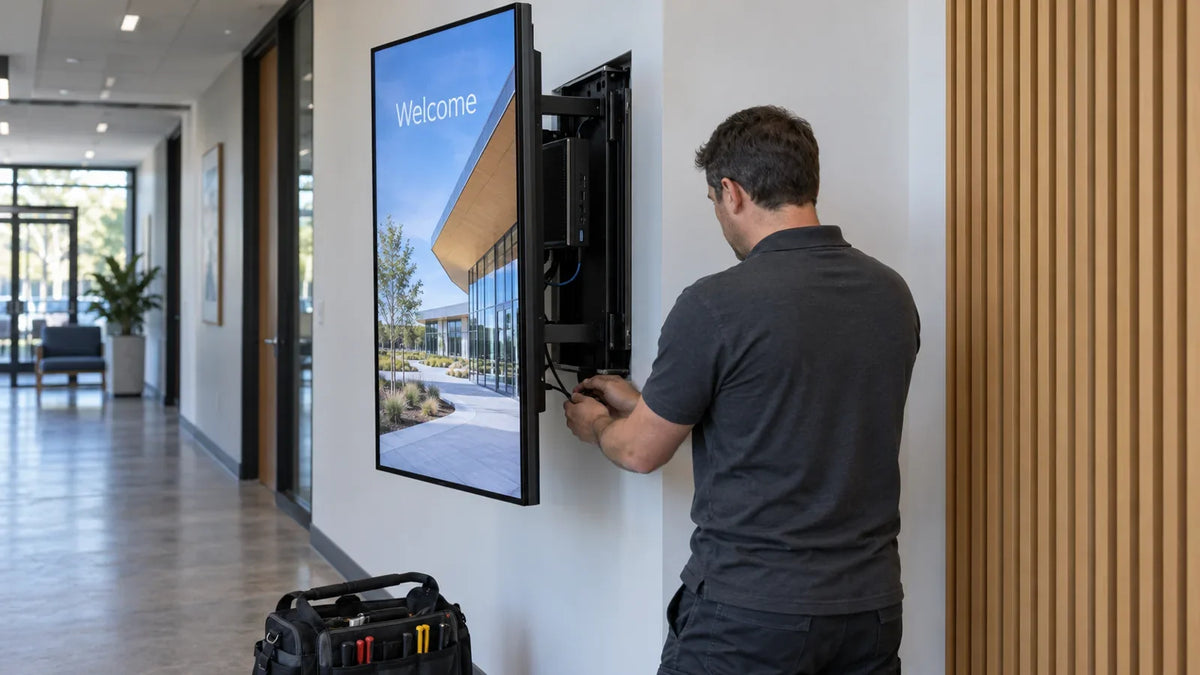
AI-generated illustration of a display service visit; not a Gemdragon installation or product photograph.
If a lobby screen has been playing a loop since 2019, nobody on the current team may know which Windows edition, version and build it runs. That gap, not the calendar date, is what makes the 13 October 2026 deadline expensive.
What actually ends on October 13, 2026
Microsoft's Windows IoT Enterprise release history, updated 29 September 2026, states that Windows 10 IoT Enterprise 2016 LTSB reaches end of support with a final monthly update on October 13, 2026. The same page gives the release as version 1607, build 14393, and lists it under two names — "LTSC 2016" in the table, "2016 LTSB" in the note. They are the same release, and the two names are why two people in one meeting can think they are discussing different systems.
The date does not apply to every Windows device on site. It applies to that release.
| Release | Version / build | Listed end of support |
|---|---|---|
| Windows 10 IoT Enterprise 2016 LTSB (also listed as LTSC 2016) | 1607 / 14393 | October 13, 2026 — final monthly update |
| Windows 10 IoT Enterprise LTSC 2019 | 1809 / 17763 | January 9, 2029 |
| Windows 10 IoT Enterprise LTSC 2021 | 21H2 / 19044 | January 13, 2032 |
| Windows 10 IoT Enterprise LTSB 2015 | 1507 / 10240 | October 14, 2025 |
Note what the table does and does not prove. A build number of 14393 puts the unit on the 1607 servicing baseline. It does not, on its own, prove that the installed edition is IoT Enterprise LTSB rather than another edition on the same build, and it says nothing about the license channel the device was activated through. Read edition, version and build together, and confirm the license channel against your own records: build is a candidate filter, not proof of what you own. The same caution applies to the wider conversation, since consumer and General Availability Channel releases run on different timelines.
One practical consequence of this being a support boundary: the units keep running. October 13 switches nothing off; what ends is regular monthly servicing. Whether an extended option applies to your devices depends on eligibility only your device OEM or Microsoft can confirm, so treat "no more updates at all" as an assumption to verify.
Find out whether you actually run 14393
Inventory before you plan. Use the following checks to build the inventory.
- On a single unit: open Command Prompt and run
winver. The dialog shows the version and build. For this release you are looking for 1607 and build 14393. - Across a network: query the build number from your management tooling of choice and export it with the device hostname, site, and the CMS group it belongs to. Settings > System > About shows the same numbers if you are working by hand.
Record the following fields per unit: hostname, site, OS edition, version and build, license channel, and player hardware model. Edition and license channel tell you whether the unit is in scope; the player model decides the route. Sort by edition and build, then by site — group the work by site while retaining a record for each device.
Four routes, and what each one replaces

There are more than two options, and the cheapest-looking one is not always the smallest change.
| Route | What changes | What you have to validate | Reasonable when |
|---|---|---|---|
| Move the existing player to a supported OS release using a validated upgrade or re-image path | OS and licensing | Application and driver compatibility, licensing entitlement, recovery image | The target OS supports the hardware and a licensed deployment and recovery path is confirmed |
| Replace the media player, keep the display | Player, mounting, cabling | Display interface behavior, control path, thermal and power budget | The panel is healthy and you have physical access |
| Move to an embedded or system-on-chip signage platform | Player layer, CMS agent, and on integrated models the display or platform layer as well | CMS feature parity, offline cache behavior, update path, and whether the player and input remain separable on that model | The network is standardized and you want fewer boxes to service |
| Run to failure with a written risk position | Nothing now | A documented risk acceptance and spare units, on the explicit assumption that no extended support option applies to these devices | The units are near retirement and the site is being replaced anyway |
Two notes on the first route. LTSC releases are licensed separately, so confirm entitlement with your device OEM or Microsoft before planning anything; do not assume the existing license covers a newer release.
Second, keep two mechanisms apart that are often conflated. A supported in-place upgrade and a clean re-image are different operations with different prerequisites and failure modes. Which one is available depends on the source and target editions, the license entitlement, the player hardware, driver availability for your peripherals, and whether you hold a recovery image. Establish that path with the OEM or platform vendor, and pilot it on one unit.
One warning on the third route. Moving to an embedded or system-on-chip platform can change more than the player layer: on some models the computing platform is integrated with the display, so the route replaces display hardware too. Before assuming a panel carries over, confirm that the player and input path are separable on that specific model. Where they are not, treat the route as a hardware replacement.
If you are weighing the second and third routes as long-term architecture rather than as a fix, that comparison has its own article: embedded player or external player, chosen by the service path.
Check whether you can keep the display
If the Windows player is separate from a serviceable display, replacing the player may let you retain the panel. Confirm the new source works with the existing display inputs, cabling and control commands before choosing that route.
This is the layer Gemdragon builds: floor-standing and wall-mounted commercial displays in 43–65 inches, for system integrators and software solution providers — which is why interface documentation matters more than a marketing specification.
Retention also depends on physical access, cable routes and the display’s condition. Inspect these on site alongside the model documentation; an integrated computing platform may require a different replacement plan.
Recheck the signal and control chain

Alongside OS, driver and CMS validation, check these four parts of the installation:
- Handshake. A new source can negotiate a different resolution or refresh rate, or fail to agree on content protection at all. Test the exact combination of player, cable and display input before you commit to a rollout.
- Cable and connector. The cable that was adequate for the old player may not carry the new one's output. Fixed installs hide this until the wall is closed again.
- Control path. If the display is switched, dimmed or scheduled over a control protocol, confirm that the new player or CMS drives the same commands. Include screen-on and screen-off scheduling in the acceptance test.
- Clearance and power. A replacement player has its own dimensions, heat output and power draw. In a sealed enclosure that is a real constraint, not a formality.
Then run a short acceptance pass on one unit before touching the fleet: power-cycle recovery, a scheduled reboot, a period offline with the network unplugged, and a continuous run covering the operating schedule you need to validate. The CMS compatibility method and the burn-in and inspection checklist give you a frozen-configuration template to reuse.
What this article cannot decide for you
Three things sit outside it: which support options your devices are eligible for, a question for your OEM or Microsoft; which route is cheapest, which depends on labor rates, site access and remaining service life; and whether a site should be migrated at all, a decision about how long that location will operate.
What it removes are the two avoidable mistakes: treating one release's end date as a fleet-wide shutdown, and replacing displays that were never the problem.
With the build number and the player model, we can tell you what needs checking on the display side of that swap. Send the OS build, the player you are moving to, and the interfaces you are keeping — start with your configuration details.